ANALYSIS: Leo XIV finds himself caught between two sides, both particularly stubborn.
The great goal of Leo XIV’s pontificate is to restore unity in the Church. The task, however, is particularly arduous. In short, it is something easier said than done.
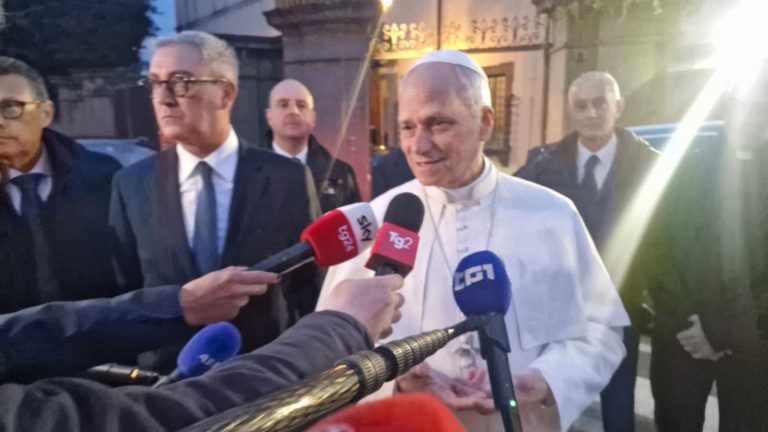
The Pontiff’s comments to journalists en route with him to Rome from Africa illustrate the point.
Leo took a question regarding Cardinal Reinhard Marx’s decision to formally bless same-sex couples, and his answer drew many different reactions, both within Germany and from around the world. However, the one that came from the head of the German hierarchy is enlightening.
Archbishop Georg Bätzing of Limburg, who is finishing his term as president of the German Bishops’ Conference, simply stated that he will continue with this pastoral practice because he does not believe it creates disunity in the Church.
That may be a parting shot from a fellow who is on his way out and doesn’t much care, or it may be Bishop Bätzing basically daring the Pope to stop him.
There is another challenge to unity looming, one that comes from the traditionalist world.
The Priestly Society of St. Pius X (SSPX) is preparing to celebrate its first episcopal ordinations since 1988.
The ordinations would be valid but not licit because they are without a pontifical mandate. One who consecrates a bishop without papal permission incurs excommunication latae sententiae, that is, for simply having committed the act.
That’s what happened to Archbishop Marcel Lefebvre and the bishops he ordained in 1988, after which a formal decree of excommunication was drafted and published.
Now, it is rumored that a similar document has already been prepared in case the SSPX decides to move forward with the planned consecrations.
In fact, these types of decrees are standard, so it’s not certain that it wasn’t ready some time ago, regardless of how the discussions within the SSPX went.
The SSPX, for its part, believes that excommunication does not actually apply to the society, reasoning that canon law does not allow the imposition of the penalty if the act that would incur it is committed in response to a perceived grave danger to the Church, or if one believes one is acting in good faith.
That is technically true, but it is the same reasoning Archbishop Lefebvre used in 1988, when a papal decree declared that the ordinations had resulted in excommunication, an indisputable fact.
In recent weeks, the SSPX also published a lengthy interview with its superior, Father Davide Pagliarani, who reiterated the society’s sense of urgency and the need to ordain new bishops to ensure its survival.
In fact, the SSPX lacks a genuine desire to even engage in dialogue with the Holy See. In previous communications, it has been made clear that it considers many of the Holy See’s decisions or approaches to be borderline heretical, and, therefore, there can be no dialogue.
In short, Leo XIV finds himself caught between two sides, both particularly stubborn.
On one side, there are those who want doctrine to evolve to the point of adapting to society because otherwise, they believe — and this is a frequently recurring phrase — the Church will no longer be relevant. On the other hand, there are those who believe the Church has evolved too much, to the point of deeming anything emanating from the Holy See inappropriate, especially in doctrinal terms.
The question to ask is simply this: Which side is Leo XIV on?
Last year, for example, it was surprising that Leo XIV sent a message of greeting to the Paris-Chartres pilgrimage, attended by thousands of mostly young people, all attached to the traditional rite, and the Pope said that he was praying for the participants. Later, the nuncio to England, Archbishop Miguel Maury Buendía,announced that Leo had asked that exceptions be made, allowing bishops to extend the celebration of the traditional Latin Mass in their dioceses upon request.
In short, Leo XIV extended a hand to the traditional world, trying to overcome the attitude of clear closure that had characterized the latter years of Pope Francis’ pontificate.
This attitude had also affected religious congregations seen as traditionalist, such as the Heralds of the Gospel, an organization started in Brazil that then spread worldwide. For years, the ordination of new priests for Heralds of the Gospel had been suspended. They were placed under special administrative review — the commissioner is Cardinal Raymundo Damasceno Assis — for abuse allegations that were never fully verified and with all civil cases ultimately ending in their favor.
After many years of stalemate, however, the group was finally granted permission to ordain 26 new priests this April.
The Heralds of the Gospel are just one example of groups deemed too traditional and thus targeted under Pope Francis. In some cases, these were very small groups, which consequently failed to gain traction.
In other cases, there was a veritable storm, as in the case of the Sodalitium Christianae Vitae — which then-Archbishop Prevost knew well — where accusations of abuse against the founder led not to a reform (as had happened with the Legionaries of Christ), but to the actual suppression of the order.
It must be said that Pope Francis’ pontificate was also influenced by a sort of “Latin American civil war” that had arisen in the post-Vatican II years, where tensions between liberation theology and more traditional movements had become almost unbearable.
Leo XIV was not affected by those tensions, even though he would have experienced them as a missionary priest and bishop in Peru. For this reason, Leo was called to find a difficult balance between the demands of those who wanted a more present and vibrant Church in terms of social issues and the need to evangelize, to bring in new vocations and foster the growth of the Church.
This is the great challenge the Pope faces in managing traditionalist groups.
The traditionalists know it, and they are spreading the narrative of a Holy See that is unwilling to listen, arguing that no agreement should be reached. The SSPX believes Leo XIV should let them proceed as they’d like, without threatening excommunication.
The penalty of excommunication, however, is necessary for the Pope to demonstrate his authority within the Church. This is why there is excommunication latae sentantiae, meaning that it is imposed automatically for having committed an excommunicable act.
Meanwhile, the idea that the Pope must accept anything in the name of an unclear principle of mercy is an argument that cannot hold up, although it has been promoted many times since the Second Vatican Council.
The theme, one can be sure, will recur repeatedly throughout Leo XIV’s pontificate. With time, it will become clear whether it is the Pope’s desire to absorb the crisis or address it, lifting the obstacles that create division and reasoning, for the sake of unity in the Church.
This article was originally published by NCRegister.
Source: https://ewtnvatican.com/articles/leo-xiv-challenge-tradition-unity