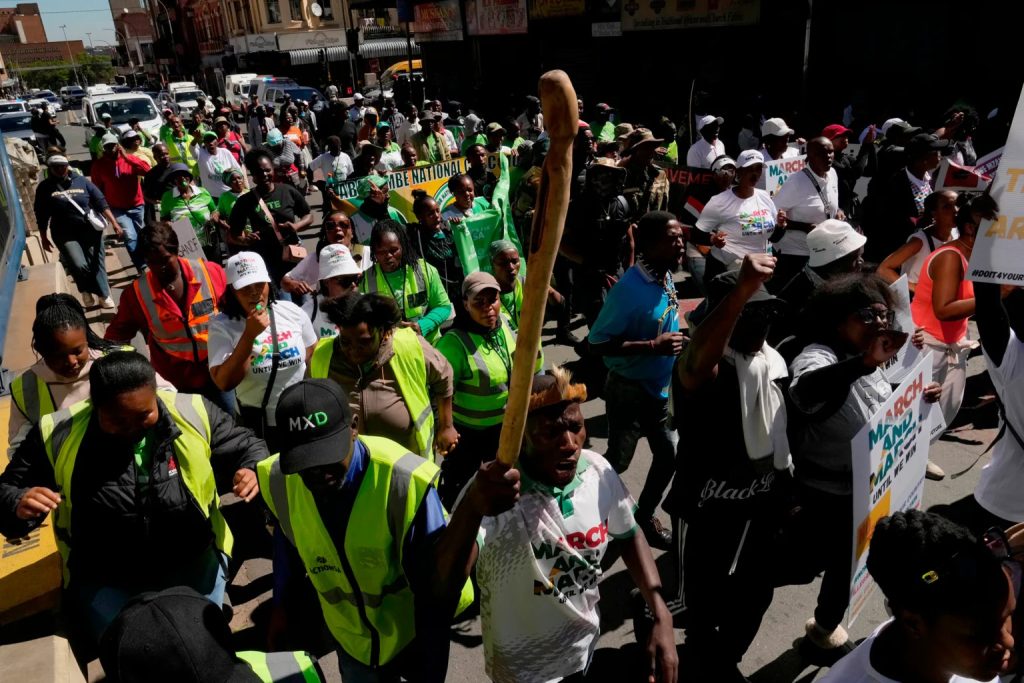
Photo Credit: South Africans protest against illegal immigration in Johannesburg, South Africa. (AP/Themba Hadebe)
Anti-Migrant Violence in South Africa has prompted Catholic leaders to call for dialogue, compassion, and support for migrants affected by growing unrest and xenophobic attacks.
Anti-Migrant Violence in South Africa continues to raise serious concerns as Catholic and Christian leaders urge communities to reject hostility, open their doors to those in need, and pursue dialogue instead of division.
Church leaders have spoken out amid a wave of attacks targeting migrants and foreign nationals across several parts of South Africa. The violence has resulted in deaths, displacement, and the destruction of homes and businesses, leaving thousands of people seeking refuge in churches, community centers, mosques, and police stations.
For the Church, the crisis is not simply a political or social issue. It is a human and moral concern that touches the dignity of every person created in the image of God.
Church Leaders Urge Compassion and Open Doors
Archbishop Sithembele Sipuka, president of the South African Council of Churches and Catholic Archbishop of Cape Town, has called on Christians to respond with compassion to migrants affected by the violence.
In a pastoral appeal titled “Do Not Turn Away the Stranger,” he urged churches to provide practical assistance, shelter, and pastoral support to those displaced by the unrest. He also encouraged communities to engage in honest dialogue about the challenges facing South Africa rather than resorting to violence or hatred.
The archbishop emphasized that the Church cannot remain silent when people are threatened because of their nationality or place of origin. He reminded Christians that the Gospel calls believers to welcome the stranger and protect the vulnerable.
Growing Humanitarian Concerns
Reports indicate that anti-migrant violence has led to deaths, widespread destruction of businesses and homes, and the displacement of thousands of migrants.
Many affected individuals have sought refuge in churches and other temporary shelters, while some have fled to remote areas out of fear for their safety. Church leaders say many displaced families lack access to food, clean water, medical care, blankets, and adequate shelter.
The unrest has also prompted concern from neighboring African countries, some of which have begun assisting citizens who wish to return home because of the deteriorating situation.
Understanding the Challenges Behind the Crisis
Church leaders acknowledge that many South Africans face legitimate concerns related to unemployment, poverty, crime, and economic hardship.
However, they insist that these challenges can never justify violence against migrants or foreign nationals.
Archbishop Sipuka has encouraged communities to listen carefully to one another, address grievances through peaceful means, and reject misinformation that fuels fear and division. He has also urged Christians to promote truth, understanding, and reconciliation.
South African President Cyril Ramaphosa similarly warned against scapegoating migrants for the country’s problems, stressing that practical solutions are needed to address economic and social challenges.
Why This Matters for Africa
The rise of Anti-Migrant Violence in South Africa has implications far beyond one country.
Africa has long been shaped by migration, cultural exchange, and regional cooperation.
When migrants become targets of violence, the effects are felt across communities, nations, and families throughout the continent.
Church leaders warn that hostility toward fellow Africans weakens unity, deepens mistrust, and undermines the values of solidarity and human dignity that many African societies cherish.
The crisis also challenges Catholics to reflect on the Gospel call to welcome the stranger and care for those in need.
What Can Catholics Learn From This?
The situation in South Africa reminds Catholics that every human person possesses inherent dignity regardless of nationality, ethnicity, language, or immigration status.
The Gospel consistently calls believers to show mercy, hospitality, and compassion.
It also reminds us of the importance of C.A.R.E.S. through Confession, Adoration, the Rosary, the Eucharist, and Sacred Scripture.
Through these spiritual practices, Catholics learn to see others through the eyes of Christ and become instruments of peace and reconciliation.
A Spiritual Resolution
As we pray for those affected by Anti-Migrant Violence in South Africa, let us commit ourselves to building a culture of encounter, compassion, and peace.
The Sacrament of Confession: Let us ask God’s forgiveness for any prejudice, indifference, or hostility we may hold toward others.
Eucharistic Adoration: Let us pray for migrants, refugees, displaced families, and all who are suffering because of violence and exclusion.
The Holy Rosary: Let us entrust South Africa and the entire African continent to the maternal care of the Blessed Virgin Mary.
The Holy Mass: Let us offer our participation at Mass for peace, healing, and reconciliation among communities affected by division.
Sacred Scripture: Let us reflect on Christ’s words: “I was a stranger and you welcomed me” (Matthew 25:35).
May hearts be opened to compassion.
May communities choose dialogue over violence.
And may Christ, the Prince of Peace, heal divisions and strengthen the bonds of human fraternity across Africa.
To remain informed about Catholic life, teachings, and inspiring stories from across Africa, readers are encouraged to visit EWTN Africa for trusted Catholic news and resources.